Official product information
How Does SodaSlim Work? The Capsule in Plain Terms
What each ingredient is proposed to do, what a standardisation is and why it makes this label checkable, and what NIH’s own weight-loss fact sheet found for every one of the five rows.
Written and reviewed by the SodaSlim Editorial Desk · Last updated September 24, 2026
Quick answer
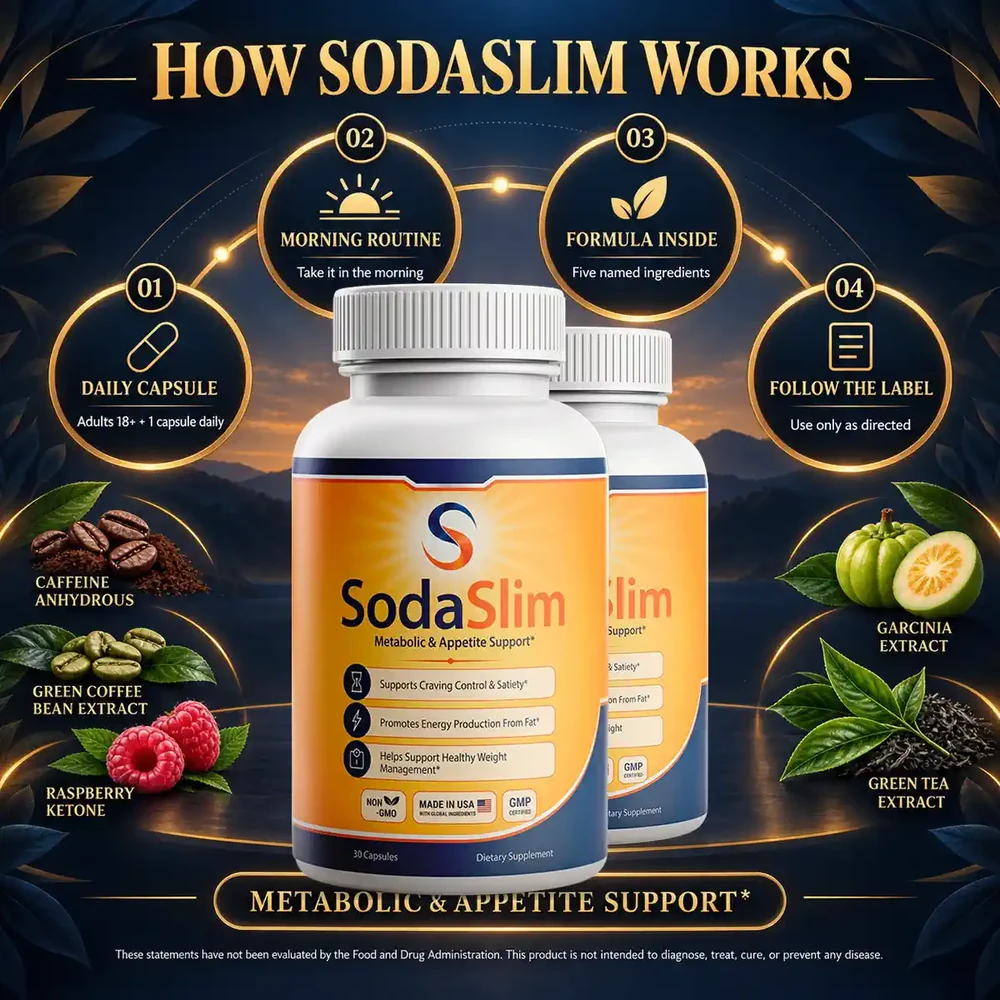
SodaSlim works as a daily capsule that pairs 138 mg of caffeine with four plant extracts.
The label makes four support claims, for appetite, cravings, energy from fat and weight management. NIH fact sheets cover all five ingredients, and this page walks through each one.
Next, see how to take it.
The claim
What the bottle proposes, in its own words
Four support claims, four asterisks, and one disclaimer printed on the same wrap.
The bottle makes four claims and every one of them carries an asterisk:
- Metabolic & Appetite Support
- Supports Craving Control & Satiety
- Promotes Energy Production From Fat
- Helps Support Healthy Weight Management
Four claims on the front, every one with an asterisk beside it, and the asterisk resolves to the FDA disclaimer printed on the same wrap. Read them carefully and they are all support claims: support, helps support, promotes. None of them says the product causes weight loss, and none names a condition. That is the label written correctly.
So the mechanism story is a modest one, told in four moves: something for appetite, something for cravings, something for energy drawn from fat, and something for weight management generally. The verbs are supports, promotes and helps support, and the distance between those verbs and the verb causes is the whole of what follows.
Vocabulary
Why this label can be checked at all
One piece of vocabulary first, because it is what makes this label auditable and most labels in this category not.
What a standardisation actually is
A botanical extract is not a substance, it is a process output. Take 130 mg of green coffee bean extract from two suppliers and you can get two very different things, because “extract” describes only that something was pulled out of a plant, not how much of the interesting compound came with it. A standardisation fixes that: when a label prints 50% chlorogenic acids beside a 130 mg figure, it is committing to a concentration — and concentration multiplied by amount is a number you can take to a research paper.
Three rows here print one. Green coffee bean extract at 50% chlorogenic acids gives about 65 mg of them. Garcinia extract at 50% HCA gives about 65 mg of HCA. Green tea extract at 45% EGCG gives about 58.5 mg of EGCG, and its “under 3% caffeine” figure is what lets you add up to 3.9 mg to the caffeine total.
Why that changes what a page like this can say
Because the alternative is unfalsifiable. A panel printing 130 mg of an unspecified extract cannot be checked against research, compared with another product, or shown to be wrong. This panel can be all three — which is how we can say its green coffee bean row sits inside the amount ODS calls safe and its garcinia row sits far below the amount the garcinia trials used. One caveat, and not a small one: a printed standardisation is the manufacturer’s claim, not a test result. No certificate of analysis was supplied to this desk. The label is auditable in principle; it has not been audited.
The evidence
What the federal fact sheet found for each of the five
ODS covers every row on this panel, which is unusual. Here is what it says about each one.
NIH ODS publishes a consumer fact sheet on dietary supplements for weight loss, and it covers every ingredient on this panel. Row by row: green coffee bean extract “might help you lose a small amount of weight”; garcinia cambogia “has little to no effect on weight loss”; green tea extract “might help you lose a small amount of weight”; raspberry ketone’s “effects on body weight are unknown” and it “hasn’t been studied enough to tell if it’s safe”; and caffeine “might help you lose a little weight or gain less weight over time”, with the note that tolerance develops. NCCIH is blunter: “The science doesn’t support the use of acai berry, bitter orange, or green tea supplements for weight loss. None of these supplements has been shown to produce meaningful weight loss in scientific studies.” And on the category as a whole, ODS: “there’s little scientific evidence that weight-loss supplements work.”
The five verdicts, lined up
Small, unknown, little to no effect, a little, small. That is the shape of the formula in five words, and not one of them is ours.
“A small amount” is a real finding and it is also a small finding. When a federal fact sheet uses that phrase it is describing a difference measured in a trial, not a difference you would see in a mirror. The honest way to read this panel is that its best-supported rows are ones ODS describes with the word small, and its worst is one ODS describes with the word unknown.
And NCCIH, which is blunter
“The science doesn’t support the use of acai berry, bitter orange, or green tea supplements for weight loss. None of these supplements has been shown to produce meaningful weight loss in scientific studies.” That names green tea supplements specifically, and green tea extract is the fifth row on this panel. The category-wide version is flatter still: “Many dietary supplements marketed for weight loss, including those sold as ‘fat burners’ or appetite suppressants, have not been tested for safety.”
None of those quotations is this site being unkind about a bottle. They are what the two federal agencies publishing consumer information on this category wrote about these ingredients, before anybody assembled this formula.
The doses
How the amounts compare with the amounts researched
Where a studied amount exists, this label sits under it. ODS says green coffee bean extract “seems to be safe (at up to 200 mg a day for 12 weeks)” — this capsule has 130 mg, inside that. Caffeine research uses “up to 400–500 milligrams a day” and this has 138 mg. Garcinia is the row where the gap is widest: the trials that exist generally use a gram or more of extract a day, and this capsule carries 130 mg of it. Raspberry ketone has no studied amount to compare against, because the human research ODS could summarise does not exist.
| Row | In one capsule | The published reference amount | What that leaves |
|---|---|---|---|
| Caffeine anhydrous | 138 mg | ODS: research uses 400-500 mg a day | About a cup of coffee. FDA cites 400 mg a day. |
| Green coffee bean extract | 130 mg | ODS: safe at up to 200 mg a day for 12 weeks | Inside the published amount. About 65 mg of chlorogenic acids. |
| Raspberry ketone | 130 mg | No studied amount published | ODS: effects on body weight are unknown. |
| Garcinia extract | 130 mg | Trials generally use a gram or more a day | About 65 mg of HCA - a fraction of the studied amount. |
| Green tea extract | 130 mg | No single studied amount | About 58.5 mg of EGCG. The liver row. |
Reference amounts are ODS’s where ODS names one, and the published trial amounts where it does not. Two rows have no reference amount at all, which is stated rather than estimated.
Reading that table without flinching either way
One row sits inside a published safe amount and the label should get credit for it: green coffee bean extract at 130 mg is comfortably under the 200 mg a day for 12 weeks ODS describes. The caffeine row is a real dose by any measure. The garcinia row is where the arithmetic is unkind — about 65 mg of HCA against trials that used a gram or more of extract a day and still produced the verdict “has little to no effect on weight loss”. And raspberry ketone cannot be read at all, because no amount of it has been studied.
The gap
What has not been tested, and what has
Everything above is about ingredients. The missing step should be explicit: no trial of this formula has been published, at these amounts, in this combination. Five ingredients each reviewed separately is not the same thing as a product tested once.
That is the ordinary condition of the category rather than a special failing of this bottle. ODS states the regulatory position plainly: dietary supplements “dietary supplements don’t require review or approval by FDA before they are put on the market”. And the responsibility sits with the company rather than with an agency: “Supplement companies are responsible for having evidence that their products are safe, and the label claims are truthful and not misleading.”
Which leaves the one mechanism nobody disputes
The most reliable sentence here belongs to MedlinePlus and it is about weight rather than about supplements: “To lose weight, you need to take in fewer calories than you use up.” It recommends “adults to get 150 minutes of physical activity each week.” and is clear about the first step: “Before you start, it’s important to check with your health care provider first.”
If a capsule helps somebody keep to that, it has done something worth having, and the label’s word support is the honest description of it. What the research does not support is the idea that the capsule is doing the work. ODS has already put a word on how much of the work it is likely to be doing, and the word is small.
Questions
SodaSlim FAQ: how it works questions
Does SodaSlim work?
No trial of this formula has been published, so nobody can answer that from evidence — including us and including the seller. What can be said is what NIH’s own fact sheet says about each of the five ingredients, and it covers all five.
What does ODS say about each ingredient?
Green coffee bean extract “might help you lose a small amount of weight”. Garcinia cambogia “has little to no effect on weight loss”. Green tea extract “might help you lose a small amount of weight”. Raspberry ketone’s “effects on body weight are unknown”. Caffeine “might help you lose a little weight or gain less weight over time”, with tolerance developing.
What does ODS say about the category?
“There’s little scientific evidence that weight-loss supplements work. Many are expensive, some can interact or interfere with medications.”
Is NCCIH any more positive?
Less. “The science doesn’t support the use of acai berry, bitter orange, or green tea supplements for weight loss. None of these supplements has been shown to produce meaningful weight loss in scientific studies.” And: “Many dietary supplements marketed for weight loss… have not been tested for safety.”
Has this exact formula been tested?
No. No trial of the combination at these amounts has been published, and none was supplied to this desk.
References
Sources for this page
- Office of Dietary Supplements, National Institutes of Health. Dietary Supplements for Weight Loss: Fact Sheet for Consumers. ods.od.nih.gov. Accessed September 24, 2026.
- National Center for Complementary and Integrative Health, NIH. 6 Things To Know About Dietary Supplements Marketed for Weight Loss. www.nccih.nih.gov. Accessed September 24, 2026.
- National Center for Complementary and Integrative Health, NIH. Green Tea. www.nccih.nih.gov. Accessed September 24, 2026.
- National Center for Complementary and Integrative Health, NIH. Garcinia Cambogia. www.nccih.nih.gov. Accessed September 24, 2026.
- MedlinePlus, U.S. National Library of Medicine. Weight Control. medlineplus.gov. Accessed September 24, 2026.
- Office of Dietary Supplements, National Institutes of Health. Dietary Supplements: What You Need to Know. ods.od.nih.gov. Accessed September 24, 2026.
Next
Keep reading
The five rows in full
Each ingredient with its amount, its standardisation and the federal verdict that covers it.
Read it →The one ingredient you can plan around
138 mg a capsule, what that is next to coffee, and how to total your day.
Read it →Claimed, and evidenced
Four support claims on the bottle, six bonus titles in the bundle, and what the fact sheets hold up.
Read it →See what SodaSlim costs on the official page
Five ingredients, five published amounts, three printed standardisations and no proprietary blend. One capsule daily, 30 capsules a bottle, thirty days. 60 days from purchase to change your mind, and the price is shown at checkout.
Price shown at checkout · 60-day window from the date of purchase · ships from inside the US · the label’s own support line is +1 (302) 200-3480