Metabolic & Appetite Support*
The headline claim, and a broad one: two propositions joined by an ampersand, each hedged with support.
Official product information
The four support claims printed on the wrap, the six bonus titles that claim more than the bottle does, the “100% natural” seal, and what the federal fact sheets actually hold up.
Written and reviewed by the SodaSlim Editorial Desk · Last updated September 24, 2026
Quick answer
SodaSlim is made to support metabolism and appetite, craving control, energy from fat and healthy weight management, as its label states.
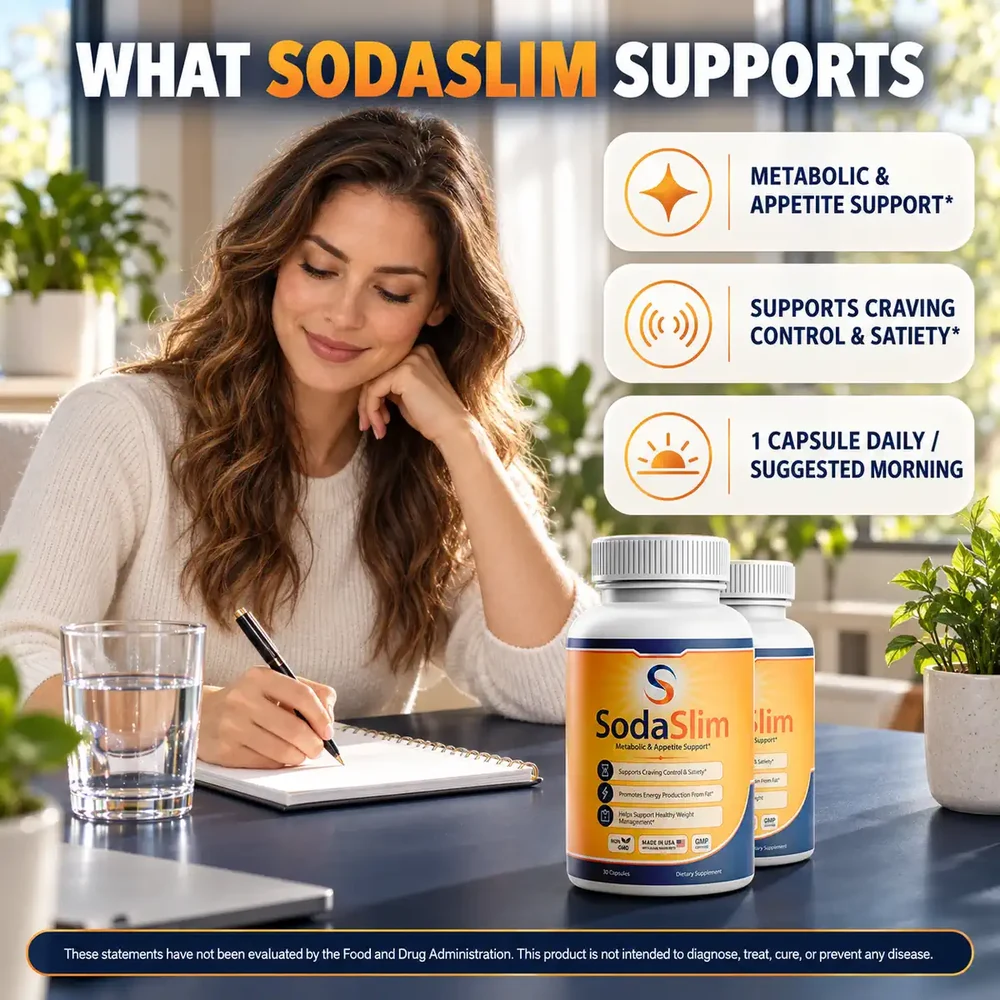
The bottle prints four support claims, each marked with an asterisk to the FDA disclaimer. This page sets each claim beside what the federal fact sheets say about the five ingredients.
To see what is inside, check the five ingredients.
Claimed
Four lines on the front of the bottle. Every one is a support claim and every one carries an asterisk.
Four claims on the front, every one with an asterisk beside it, and the asterisk resolves to the FDA disclaimer printed on the same wrap. Read them carefully and they are all support claims: support, helps support, promotes. None of them says the product causes weight loss, and none names a condition. That is the label written correctly.
The headline claim, and a broad one: two propositions joined by an ampersand, each hedged with support.
Note the verb: supports, not produces. No federal fact sheet on these five ingredients reports a measured effect on appetite or satiety.
The most technical-sounding line on the bottle and still a support claim: it describes a process rather than an outcome.
Doubly hedged — helps support. This is the wording a label uses when it may not say causes weight loss, and it may not.
Four claims, four asterisks, one disclaimer. That is a label doing the thing labels in this category routinely fail to do, which is why this page is about a distance rather than a deception.
The rule
These four lines are structure/function claims, a defined thing rather than marketing freestyle. FDA’s own description: such a claim may “Describe the role of a nutrient or dietary ingredient intended to affect the normal structure or function of the human body, for example, ‘calcium builds strong bones.’”
It permits a sentence about a normal bodily process. It forbids a claim that a product can diagnose, treat, cure or prevent a disease, which only an approved drug may say. And it comes with two conditions: the disclaimer, tied to all four claims by the asterisk, and substantiation — “These three types of claims are not pre-approved by FDA, but the manufacturer must have substantiation that the claim is truthful and not misleading and must submit a notification with the text of the claim to FDA no later than 30 days after marketing the dietary supplement with the claim.”
Read that carefully. Nobody at FDA approved these four claims. The company must hold evidence that they are truthful and not misleading and must notify FDA of the wording, but the evidence stays with the company, and FDA’s role arrives afterwards: “FDA has the authority to take action against any adulterated or misbranded dietary supplement product after it reaches the market.”
A reader who sees four asterisks sometimes concludes the company is hedging. The opposite is closer to true: a label carrying these four lines without a disclaimer would be the misbranded one.
Evidenced
ODS covers all five rows. Its verdicts run small, unknown, little to no effect, a little, small.
So much for what the bottle may say. The other column is what the federal consumer fact sheets support — and those sheets exist for all five ingredients, which makes this a comparison rather than a shrug.
NIH ODS publishes a consumer fact sheet on dietary supplements for weight loss, and it covers every ingredient on this panel. Row by row: green coffee bean extract “might help you lose a small amount of weight”; garcinia cambogia “has little to no effect on weight loss”; green tea extract “might help you lose a small amount of weight”; raspberry ketone’s “effects on body weight are unknown” and it “hasn’t been studied enough to tell if it’s safe”; and caffeine “might help you lose a little weight or gain less weight over time”, with the note that tolerance develops. NCCIH is blunter: “The science doesn’t support the use of acai berry, bitter orange, or green tea supplements for weight loss. None of these supplements has been shown to produce meaningful weight loss in scientific studies.” And on the category as a whole, ODS: “there’s little scientific evidence that weight-loss supplements work.”
The bottle’s strongest claim is “helps support healthy weight management”. The strongest thing ODS says about any ingredient in it is that it “might help you lose a small amount of weight”. Those are not in conflict, and that is the point: the label is claiming exactly as much as the word support can carry — much less than a reader in a hurry will hear.
“A small amount” is a real finding and it is also a small finding. When a federal fact sheet uses that phrase it is describing a difference measured in a trial, not a difference you would see in a mirror. The honest way to read this panel is that its best-supported rows are ones ODS describes with the word small, and its worst is one ODS describes with the word unknown.
“Supports craving control & satiety” is the line we can find least for. NCCIH notes that garcinia products “garcinia cambogia products with HCA are promoted as a dietary supplement for appetite control and weight loss.” — promoted, a statement about marketing rather than effect — and then reports: “It’s unclear whether garcinia cambogia products help with weight loss. Some evidence suggests a modest effect, while other evidence shows no effect.” The claim is permitted. It is not evidenced.
The bundle
The bottle never promises a result. Two of the six free ebooks promise one in their titles.
Six digital bonuses arrive with the larger packs, and their titles are worth reading against a label that never promises a result. “Accelerated Metabolism” and “10-Day Metabolic Challenge” both describe a change in rate; the bottle says “metabolic support”. “Facial Rejuvenation” is about skin, which the panel has nothing to do with at all. The others are a “Renova Flora Protocol”, a “Sleep Live Better” guide and a “Personalized Usage Guide”. Nobody has to substantiate the title of a free download.
When a supplement ships with reading material, read the titles before the label. A correctly written label inside a bundle whose covers promise acceleration and rejuvenation is a common shape, and the bundle is the half nobody has to defend.
A book title is not a claim about a product, so nobody has to hold evidence for it — but it arrives in the same order, in the same email, describing the same purchase, and the reader does not separate the two. The bottle says metabolic support. The bundle says accelerated metabolism. It is the unsubstantiated phrase that is doing the persuading.
The supplied pack ships a 100% NATURAL INGREDIENTS roundel. The largest single row on this panel is caffeine anhydrous — caffeine dried to a powder, manufactured rather than brewed — and raspberry ketone sold at this price is, in practice, synthesised rather than extracted from raspberries. “Natural” has no fixed legal meaning on a US supplement label. NCCIH puts the general point plainly: “‘Natural’ does not necessarily mean ‘safe.’”
That mark is not on the bottle, which carries three: non-GMO, made in USA and GMP certified. The natural roundel is in the marketing pack, above a panel whose largest row is a powder made in a factory. ODS, on all twelve supplied marks: “These seals do not guarantee that a product is safe or effective.”
The balance
One list of what this product documents well and one of what it does not, because on this product the panel and the marketing deserve different verdicts.
The left column is a label. The right column is mostly a marketing pack, plus four findings that belong to the formula itself: the garcinia verdict, the raspberry ketone verdict, the two liver rows and the caffeine. Decide from those four and from the arithmetic on the caffeine page.
And one piece of plain speech. Nothing on this site can tell you what this capsule will do for you, because no trial of this formula has been published. What it can tell you is what is in the capsule, in what amount, what two federal agencies have written about each of those amounts, and how much caffeine you will be adding to your day. MedlinePlus supplies the rest: “Before you start, it’s important to check with your health care provider first.”
Questions
Almost certainly the caffeine, if you are not already a regular coffee drinker: more alertness within an hour, and possibly worse sleep if you take it late. That is the one predictable effect in the bottle.
Mixed, and this is where the standardisations earn their keep. Green coffee bean at 130 mg is inside the 200 mg ODS describes as safe for 12 weeks. Caffeine at 138 mg is well under the 400–500 mg research range. Garcinia is the gap: trials generally use a gram or more a day and this carries 130 mg of extract, about 65 mg of HCA.
Six digital titles: “Accelerated Metabolism”, “10-Day Metabolic Challenge”, “Facial Rejuvenation”, “Renova Flora Protocol”, “Sleep Live Better” and a “Personalized Usage Guide”. Several of those titles claim more than the bottle does.
No. ODS: dietary supplements “don’t require review or approval by FDA before they are put on the market”. NCCIH: marketers “do not have to prove to the Food and Drug Administration that it is safe or that it works before it arrives on grocery store shelves”.
References
Next
What a standardisation is, and what ODS found for every one of the five rows.
Read it →The panel in its printed order, with the calculable active for the three standardised rows.
Read it →138 mg a capsule against the 400 mg FDA cites, with the drink figures to total your day.
Read it →Four support claims on the wrap, all correctly disclaimed, over a panel of five ingredients with five published amounts. One capsule daily, 30 capsules a bottle, thirty days. 60 days from purchase to change your mind; the price is shown at checkout.
Price shown at checkout · 60-day window from the date of purchase · ships from inside the US · the label’s own support line is +1 (302) 200-3480