SodaSlim blog
The Same Person in Different Clothes
The photographs were not of customers, and the files said so before we opened them.
Start here
The cheapest element on the page
Every sales page in this category has the same spine. A headline, a bottle on a plinth, a panel of ingredients if you are lucky — and then, two-thirds of the way down, a strip of faces: three or four people in ordinary rooms, holding the bottle towards the camera, each with a paragraph underneath in the first person.
That strip is worth thinking about as manufacturing rather than as evidence, because of an awkward asymmetry. Of everything on the page it is the cheapest element to fabricate — a stock licence, an afternoon in a rented flat, a caption written by whoever wrote the rest of the page. And it is the most persuasive element to a reader, because a face is processed faster than a number and trusted more readily than a table.
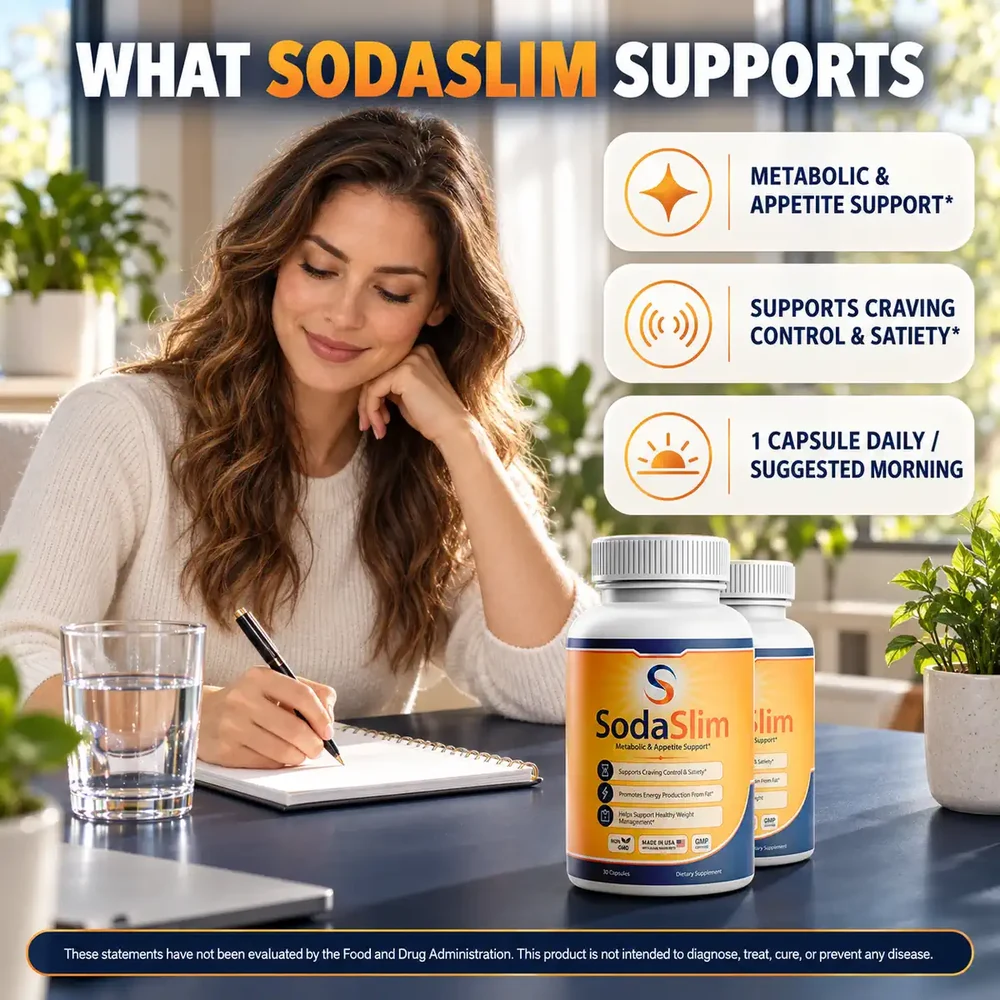
The pack supplied for SodaSlim demonstrates that asymmetry about as plainly as it can be demonstrated, and it did so accidentally, in its own filenames.
The evidence
What arrived in the supplied pack
The supplied asset pack contains a set of customer photographs, and the pack named them itself. Three portraits arrived with the filenames same-person-different-clothes-1, same-person-different-clothes-2 and same-person-different-clothes. Two further images, styled as a strip of polaroids captioned as real buyers, show the same three people again — different clothes, a different room, each holding the bottle up to the camera as though they had photographed themselves at home. A fourth headshot is filed under a person’s full name on a plain white background. None of these images appears anywhere on this site. Publishing them would manufacture customers who do not exist, and the filenames make it impossible to pretend otherwise.
Be precise about what that implies. Three portraits arrived as separate files, each meant to be read as a separate person; the filenames describe one person twice over. The two strips are styled as polaroids — white borders, a slight tilt, the grammar of a photograph taken at home and sent in — and they show those same three people again, in different clothes and a different room, each holding the bottle at the same angle. The fourth is a headshot on plain white under a person’s full name, which is the detail that makes the set feel specific. A name on a file is not a person.
The three portraits, both polaroid strips and the named headshot are all in the supplied pack and none is published here, because printing them would manufacture buyers who do not exist.
The mechanism
Why a face outranks a panel
Why does a strip of faces do so much work? Partly because of what it replaces. A panel of milligrams asks you to know something about milligrams. A federal fact sheet asks you to read three paragraphs of careful hedging. A face asks nothing and hands you a conclusion.
It answers the question nobody prints
The label on this bottle is careful. Every claim on the front is a support claim, each carrying an asterisk that resolves to the FDA disclaimer on the same wrap. No supplement label may promise a result and this one does not try. The gallery is where the promise goes instead — not in words a regulator would read as a claim, but in an implication assembled out of a person, a room and a bottle. NCCIH puts the reading habit plainly: “Ask yourself if a product sounds too good to be true. Be cautious if the claims for the product seem exaggerated or unrealistic and use phrases like ‘quick and effective’ or ‘totally safe.’”
The method
Four checks on any gallery
Look for the same face twice
Scroll the gallery again looking only at faces, ignoring clothes and rooms. A repeated jawline in a different jumper is the strongest tell there is, and it is common because stock sets are shot in batches with one model and several changes.
Look for studio lighting on a “selfie”
A photograph taken at arm’s length in a real kitchen has one hard light source and shadows where the window is. A stock frame has soft, even light on both sides of the face. A self-portrait lit like a catalogue was shot like one.
Look for the same holding angle
Compare how the bottle sits in each hand: the same height, the same tilt, the label square to the lens every time. People photographing themselves do not converge on one composition. Art directors do, because the label has to be legible.
Then check the room, the floor and the plant
Backgrounds are reused more often than faces. The same skirting board or pot plant behind two different people means one location and one shoot.
None of those needs a tool or any technical skill, and together they take about a minute. Run them before you read a caption, because once you have read the captions the faces stop being photographs and start being people.
The copy
Then read the sentences
The fifth check is not visual, and on this pack it is the one that closes the question. Read the paragraphs underneath the faces, side by side, as text. Real writing from different people diverges immediately: in length, in what it mentions, in how it handles a complaint. Copy written to fill a template converges. Here, four of the eight named buyers carry one sentence word for word and three more share a second, which is not how eight strangers write. The pack is candid about the reason, describing its own review block in its own words as layout copy — a designer’s note never meant to reach a buyer, and worth more than any of the reviews it describes.
What that does to the numbers beside them
A star score and an order count computed from that block are the same object as the block. Which is why no review, no star rating and no buyer count appears anywhere on this site, and no rating markup sits in the page source either. A figure you cannot stand behind is worse than none, because it looks like one you can.
Credit where due
What this does not tell you
This says nothing about the capsule
A staged gallery is a fact about a marketing department, not about a formula. Nothing in the filename of a stock photograph tells you whether the powder in the bottle is what the panel says it is, and it would be sloppy reasoning to pretend otherwise.
And the panel here is the best in this series
Five ingredients, five amounts, no proprietary blend — and three of the five carry a printed standardisation, which is better practice than most labels in this series manage. You can work out that this capsule contains about 65 mg of chlorogenic acids, about 65 mg of HCA and about 58.5 mg of EGCG, because the label gives you the arithmetic to do it.
So the finding sets a discount rate rather than a verdict. Everything on that page which depends on buyers comes off the same production line as the photographs and should be read at the same value. Everything that can be checked from outside — the printed panel, the declared amounts, the federal fact sheets covering all five ingredients — is untouched by any of it and remains checkable.
Generalising
The rule worth carrying
The rule
Customer photographs are the cheapest thing on a sales page to fake and the most persuasive thing on it to a reader. If the same face appears twice in two different outfits, if everyone is holding the bottle at the same angle, or if the lighting on a “selfie” is studio lighting, you are looking at a photoshoot. It says nothing about whether the capsule works — but it tells you exactly how much weight to put on everything else the page says about buyers.
A gallery cannot be verified from outside by anybody, which is why the sensible move is to give it no weight at all rather than to try to grade it. Put the weight on what can be checked, and the gallery becomes decoration.
Closing
What to do with this
The honest version
Discount everything this page says about buyers, all the way to zero, and read the label instead — where this product does considerably better than its own marketing. The reviews page explains in full why no buyer is quoted here, the testimonial checklist covers the tells that survive a crop, and the supplement facts page prints the whole wrap line by line. The bottle’s own caution line still outranks all of it: if you take a medication or have a medical condition, speak to a clinician before you start.
References
Sources
- National Center for Complementary and Integrative Health, NIH. 6 Things To Know About Dietary Supplements Marketed for Weight Loss. www.nccih.nih.gov. Accessed September 24, 2026.
- Office of Dietary Supplements, National Institutes of Health. Dietary Supplements: What You Need to Know. ods.od.nih.gov. Accessed September 24, 2026.
- U.S. Food and Drug Administration. Structure/Function Claims. www.fda.gov. Accessed September 24, 2026.
Order SodaSlim from the official page
30 capsules a bottle, one capsule a day, so thirty days a bottle. Five ingredients with five published amounts and no proprietary blend, three of them carrying a printed standardisation — which is the reason every check on this site can be run at all. 138 mg of caffeine a capsule, so count it against your day. 60 days from purchase to change your mind. The order desk is +1 (302) 200-3480.
Price shown at checkout · 60-day window from the date of purchase · ships from inside the US · the label’s own support line is +1 (302) 200-3480
Next
Keep reading
Why no buyer is quoted here
The supplied pack calls its own review block layout copy, and four of its eight named buyers share one sentence.
Read it →Spotting a staged testimonial
The longer checklist, with the tells that survive a cropped photograph.
Read it →A logo is not a citation
The same page also shipped five journal wordmarks with no article behind any of them.
Read it →